
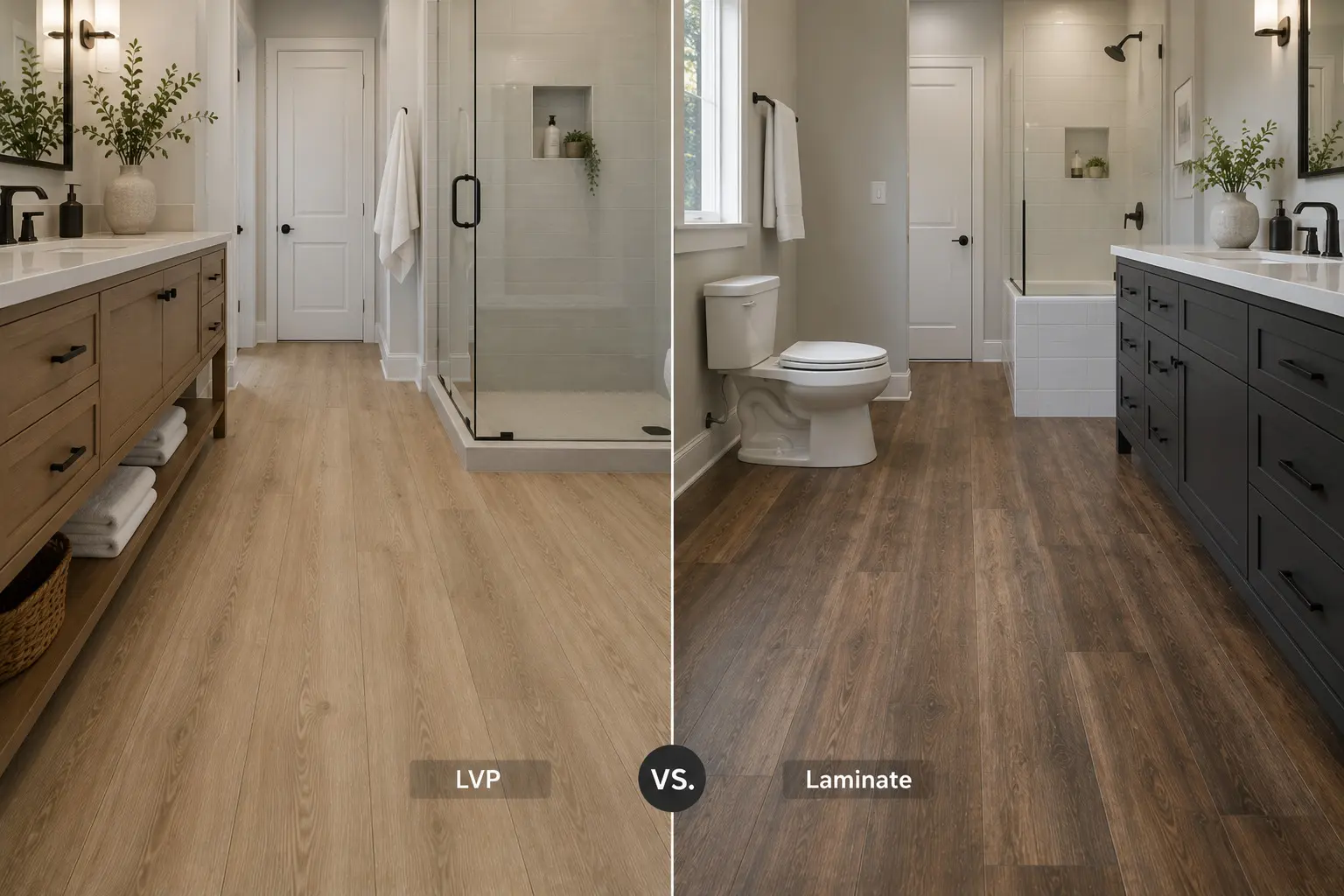
Choosing between laminate flooring and luxury vinyl plank flooring can be challenging because both options offer attractive wood-look designs, practical maintenance, and alternatives to traditional hardwood. They are available in a wide variety of colors, textures, plank sizes, and finishes, making them suitable for many modern homes. However, they differ in construction, water resistance, durability, comfort, and installation requirements.
When comparing laminate flooring vs LVP, the most important factor is how you plan to use the space. Laminate can be an excellent choice for living rooms, bedrooms, and other areas where a realistic wood appearance is a priority. Luxury vinyl plank, commonly called LVP, is often preferred in areas where spills and moisture are more likely, such as kitchens and laundry rooms.
Both flooring types have advantages and limitations, and neither is automatically the best choice for every home. Understanding their differences can help you select flooring that matches your budget, lifestyle, and design preferences.
What Is Laminate Flooring?
Laminate flooring is a manufactured flooring product designed to imitate materials such as hardwood, stone, or tile. Most laminate planks contain several layers, including a protective surface, a decorative image layer, a dense core, and a stabilizing backing.
The decorative layer provides the wood-look appearance, while the protective surface helps resist everyday scratches, stains, and wear. Many modern laminate products feature embossed textures that resemble natural wood grain, creating a realistic finish.
Laminate flooring is commonly installed using a click-lock system that allows planks to connect without being permanently attached to the subfloor. This floating installation method can make it suitable for renovations and some DIY projects.
One of laminate’s main attractions is its combination of visual appeal and affordability. It is available in styles ranging from pale oak and warm maple to darker walnut-inspired designs. Depending on the product, laminate may offer a harder surface and a convincing wood-like texture.
However, traditional laminate has a core that can be damaged by prolonged moisture exposure. Some newer products feature water-resistant or waterproof claims, but buyers should carefully check what those claims cover and follow the manufacturer’s installation requirements.
What Is LVP Flooring?
Luxury vinyl plank flooring, or LVP, is a synthetic flooring product designed to resemble natural wood. It typically includes a protective wear layer, a printed decorative layer, and a vinyl-based construction. Some products also feature a rigid core made from materials such as stone plastic composite or wood plastic composite.
LVP is popular because it combines realistic designs with practical water resistance. Many products are waterproof at the plank level, making them suitable for rooms where accidental spills are common.
Luxury vinyl planks come in different widths, lengths, textures, and colors. Some designs closely imitate the grain and appearance of hardwood, while others feature contemporary finishes that work well in modern interiors.
Depending on the product, LVP can be installed as a floating click-lock floor or attached to the subfloor with adhesive. The correct method depends on the manufacturer’s specifications and the conditions of the room.
LVP is often chosen for kitchens, bathrooms, laundry areas, basements, and busy family spaces. However, its performance still depends on product quality, subfloor preparation, installation, and maintenance.
Laminate Flooring vs LVP: Key Differences
Although laminate and LVP may look similar after installation, their construction and performance characteristics differ in several important ways.
| Feature | Laminate Flooring | LVP Flooring |
|---|---|---|
| Main construction | Decorative surface over a dense fiberboard-based core in many products | Vinyl-based construction, sometimes with a rigid composite core |
| Water resistance | Varies; traditional laminate can swell if moisture reaches the core | Many products are waterproof at the plank level |
| Appearance | Often offers realistic wood grain and textured finishes | Offers realistic wood-look designs and a range of surface textures |
| Scratch resistance | Often performs well against everyday surface wear, depending on the product | Varies by wear layer and product quality |
| Comfort | Usually firm underfoot | May feel slightly more resilient, depending on construction |
| Installation | Commonly uses a click-lock floating system | May use click-lock floating or adhesive installation |
| Maintenance | Generally easy to clean; moisture precautions are important | Generally easy to clean; product-specific care is required |
| Suitable areas | Living rooms, bedrooms, dining rooms, and dry areas | Living rooms, bedrooms, kitchens, and other approved moisture-prone areas |
| Repair | Damaged planks may be replaceable, but repairs can be difficult | Individual planks may be replaceable depending on the installation system |
| Cost | Often affordable, with premium products costing more | Wide range of prices depending on quality and construction |
These are general comparisons rather than guarantees. Flooring performance varies by brand, product specifications, installation conditions, and the manufacturer’s warranty.
Water Resistance: Which Flooring Is Better?
Water resistance is one of the biggest differences between laminate flooring and LVP.
Traditional laminate flooring typically has a fiberboard-based core. If water enters through joints or exposed edges and remains there, the core can absorb moisture, swell, or lose its original shape. This can result in raised edges, damaged joints, or permanent changes to the planks.
Some modern laminate products have improved moisture-resistant surfaces and locking systems. Certain manufacturers also offer products marketed as waterproof for specific periods or conditions. However, the exact warranty terms matter because waterproof claims may depend on correct installation and prompt spill cleanup.
LVP is often the preferred choice when moisture resistance is a major concern. Many products are waterproof at the plank level, making them useful in kitchens, laundry rooms, and other areas where spills can occur.
It is important to distinguish between a waterproof plank and a waterproof flooring installation. Water can still enter around the edges, transitions, or beneath the floor. Neither laminate nor LVP automatically solves groundwater problems or excessive moisture in a concrete subfloor.
Best choice: LVP is generally the safer starting point for moisture-prone rooms, provided the specific product is approved for the location and installed correctly.
Durability and Scratch Resistance
Both laminate and LVP are designed to handle everyday household use, but their durability depends on the product’s construction and protective surface.
Laminate often has a hard wear surface that can perform well against everyday scuffs and scratches. This can make it attractive for living rooms, dining areas, and other spaces where furniture and foot traffic are common.
LVP uses a protective wear layer to help resist surface damage. The thickness and quality of this layer can influence its performance. A product with a more robust wear layer may be suitable for a busy household, but the overall core construction and locking system also matter.
Neither option is completely scratch-proof or dent-proof. Dragging heavy furniture, dropping sharp objects, or allowing grit to accumulate can damage either floor. Heavy furniture can also place concentrated loads on the locking joints or core.
To extend the life of both flooring types, use furniture pads, lift rather than drag heavy items, and sweep regularly. In homes with pets, check the product’s scratch-resistance specifications and warranty rather than relying only on marketing descriptions.
Best choice: Laminate may be appealing for its hard surface, while high-quality LVP can provide excellent everyday durability. Compare individual product specifications instead of assuming one category always performs better.
Appearance and Design Options
Laminate flooring and LVP both offer extensive design choices, including natural oak, maple, walnut, grey wood, rustic finishes, and contemporary colors.
Laminate can deliver a convincing wood appearance because its decorative layer reproduces detailed grain patterns. Embossed textures may also create a surface that feels closer to natural timber. Many homeowners choose laminate when they want the appearance of hardwood without paying for solid wood flooring.
LVP also offers realistic printed designs, including varied wood grains, knots, and textured surfaces. Some premium products feature embossed-in-register textures that align the surface texture with the printed grain pattern.
Both categories offer wide planks, narrow boards, and different finishes. The final appearance depends on the quality of the printed design, the amount of pattern variation, the plank dimensions, and how the flooring is installed.
Lighting can affect how a floor color looks in a room. Before buying, compare samples beside your furniture, walls, and cabinetry. Check them in daylight and artificial lighting to make sure the color suits the space.
Best choice: Neither flooring type is automatically superior in appearance. High-quality examples of both can look realistic, so compare physical samples rather than relying only on product photographs.
Comfort and Feel Underfoot
The feel of flooring can influence everyday comfort, particularly in kitchens, bedrooms, and living areas where people spend considerable time standing or walking.
Laminate generally has a firm surface. Depending on the underlayment and subfloor, it may feel solid and stable underfoot. However, some laminate installations can sound hollow or produce a noticeable clicking noise if the subfloor is uneven or the underlayment is unsuitable.
LVP can feel slightly more resilient because of its vinyl-based construction. Some products include an attached underlayment that may improve comfort and reduce certain types of footfall noise.
Nevertheless, not all LVP is soft or quiet, especially rigid-core varieties. The final feel depends on the product, the backing, the installation method, and the subfloor beneath it.
For either flooring type, follow the manufacturer’s underlayment requirements. Adding an incompatible underlayment can affect the locking system, cause movement, or invalidate warranty coverage.
Best choice: LVP may appeal to people who prefer a slightly more resilient surface, while laminate can offer a firm, stable feel. Testing samples in person can help you decide.
Installation: Laminate vs LVP
Both laminate flooring and LVP can be suitable for DIY installation, especially when the products use click-lock systems. However, the installation process depends on the product and the condition of the room.
Laminate flooring is commonly installed as a floating floor. The planks connect to one another while the floor remains separate from the subfloor. Depending on the product, an underlayment may be required.
LVP is available in both floating and glue-down formats. Click-lock LVP can be straightforward to install in suitable rooms, while glue-down products require the correct adhesive, surface preparation, and installation technique.
Subfloor preparation is essential for both options. The surface should meet the manufacturer’s requirements for flatness, cleanliness, and moisture conditions. Uneven concrete or damaged wood subfloors can cause joint problems, movement, or premature wear.
Before installation, measure the room, plan the plank direction, and check the starting and ending rows. Follow the required expansion gaps and transitions. Some products also have specific temperature or acclimation requirements.
If the room contains many corners, doorways, irregular walls, or moisture concerns, professional installation may be worthwhile.
Cost Comparison: Laminate Flooring vs LVP
The cost of laminate and LVP varies by product quality, thickness, surface finish, wear specifications, and installation method. Both categories include budget-friendly options and premium products.
Laminate may offer an attractive initial price for homeowners who want a realistic wood-look floor in a dry room. Higher-end products can cost more because of improved surface textures, construction, and warranties.
LVP prices vary widely depending on whether the product is flexible or rigid-core, its wear layer, attached underlayment, and the design quality. Waterproof products and premium rigid-core options may cost more than basic vinyl planks.
The full project budget should include more than the flooring itself. Additional expenses may involve:
- Underlayment or adhesive, where required.
- Removal and disposal of existing flooring.
- Subfloor repairs and leveling.
- Moisture testing or mitigation.
- Trims, transitions, and finishing accessories.
- Installation labor and delivery.
- Extra material for cutting waste and future repairs.
When comparing quotes, ask installers to separate material and labor costs. This makes it easier to understand the total investment and identify services that may not be included.
Best choice: Laminate may be more economical for some dry-room projects, but the price difference depends on the specific products. Compare total installed costs rather than judging by the price per plank alone.
Which Flooring Is Better for Kitchens and Bathrooms?
Kitchens and bathrooms experience more moisture exposure than many other rooms, so flooring selection requires particular care.
LVP is often a practical choice for kitchens because many products are waterproof at the plank level and can handle ordinary spills when installed according to the manufacturer’s instructions. It is also available in designs that coordinate with cabinets, countertops, and other interior finishes.
Traditional laminate can be more vulnerable if water reaches its core and remains there. Certain modern laminate products offer improved moisture resistance, but they should only be installed in kitchens or bathrooms when the manufacturer explicitly approves the intended use.
Bathrooms require additional attention because water can collect around toilets, showers, tubs, and plumbing fixtures. Even waterproof LVP does not automatically create a waterproof room, and the edges and subfloor still need appropriate detailing.
For both flooring types, clean spills promptly and investigate any persistent moisture. Do not install flooring over a damp concrete slab without confirming that the product and installation system are suitable.
Best choice: LVP is often the more straightforward option for kitchens and approved moisture-prone areas. For bathrooms, confirm the manufacturer’s specific approval and the requirements for the complete installation.
Which Flooring Is Better for Basements?
Basements and below-ground rooms can experience moisture vapor, condensation, or groundwater issues. These conditions should be assessed before choosing a floor covering.
LVP is often selected for basements because many products resist water at the plank level. However, a waterproof plank cannot prevent moisture from moving through a concrete slab, and trapped moisture may create problems beneath the floor.
Laminate can also be used in some basements when the product is approved for the conditions and the subfloor meets the manufacturer’s moisture requirements. Traditional laminate is generally less forgiving if moisture reaches its core.
Before installing either material, inspect the basement for leaks, damp patches, cracks, and musty odors. Conduct the required moisture tests and address any active water problems.
The correct solution may involve drainage improvements, a suitable moisture-control system, or professional assessment before flooring is installed.
Best choice: LVP is often the preferred option for basements, but the moisture condition of the subfloor must still be checked. Persistent dampness should be resolved rather than covered.
Environmental and Indoor Air Quality Considerations
Indoor air quality can be an important consideration when choosing manufactured flooring. Both laminate and LVP may contain adhesives, binders, coatings, or other materials that can release volatile organic compounds, depending on their construction.
Product quality and manufacturing standards vary, so buyers should look for reliable information about emissions and applicable certifications. Ask manufacturers for technical documentation rather than assuming all products in a category have identical characteristics.
Laminate often contains a fiberboard core made using wood fibers and binders. LVP is generally vinyl-based and has a different material composition. These differences may matter to homeowners who have specific environmental preferences.
Waste management is another consideration. Flooring removal can generate material that is difficult to recycle through ordinary household programs, and recycling options depend on local facilities and the product’s construction.
For a more informed decision, compare product durability, emissions information, warranty coverage, expected maintenance, and available end-of-life options.
Pros and Cons of Laminate Flooring
Laminate offers several advantages, but its limitations should be considered before installation.
Pros:
- Realistic wood-look designs and surface textures.
- Often a good balance of appearance and price.
- A hard surface that can perform well against everyday wear.
- Common click-lock installation systems.
- Wide choice of colors, plank sizes, and finishes.
Cons:
- Traditional products can swell if moisture reaches the core.
- Damaged areas usually cannot be sanded and refinished like solid hardwood.
- Some installations can sound hollow without a suitable subfloor and underlayment.
- Not every product is approved for bathrooms or damp basements.
- Repairs may be difficult if the damaged planks are in the middle of a floating floor.
Laminate is often a strong choice for dry living areas when appearance, cost, and everyday surface durability are priorities.
Pros and Cons of LVP Flooring
LVP offers practical benefits, particularly in rooms where spills and cleaning are common.
Pros:
- Many products are waterproof at the plank level.
- Available in realistic wood-inspired designs.
- Generally easy to clean and maintain.
- Suitable options exist for kitchens and other approved moisture-prone rooms.
- Floating click-lock and glue-down installation choices are available.
Cons:
- Surface quality and scratch resistance vary by product.
- Heavy loads or sharp objects can dent or damage the floor.
- Some products may feel less like natural wood underfoot.
- Waterproof planks do not eliminate subfloor moisture problems.
- Some premium products can be expensive, especially after installation.
LVP is often a sensible option for busy households that want a low-maintenance floor with good resistance to everyday spills.
How to Choose Between Laminate Flooring and LVP
The best choice depends on the conditions of the room and the features you value most.
Choose laminate if you are flooring a relatively dry space and find a product whose appearance, texture, price, and durability meet your needs. It can work particularly well in bedrooms, living rooms, and dining areas.
Consider LVP if moisture resistance is a priority or you want a practical surface for a kitchen, laundry area, or suitable basement. Check the product’s wear layer, core construction, warranty, and installation requirements before purchasing.
For either option, compare physical samples, check the manufacturer’s technical specifications, and obtain a full installation estimate. The quality of the product and preparation of the subfloor can make a major difference to long-term performance.
Frequently Asked Questions About Laminate Flooring vs LVP
Is LVP better than laminate flooring?
LVP is often better for areas where moisture resistance is important, while laminate may be attractive for dry rooms where realistic wood appearance and a firm surface are priorities. The best option depends on the exact products and the intended location.
Which flooring lasts longer, laminate or LVP?
Both can provide years of service when properly selected, installed, and maintained. Lifespan depends on product quality, surface wear, traffic, moisture exposure, and installation conditions. Review the manufacturer’s warranty and technical specifications instead of relying on a universal lifespan estimate.
Is laminate flooring more scratch-resistant than LVP?
Some laminate products have hard, scratch-resistant wear surfaces and may perform well against everyday scuffs. LVP performance depends on its protective wear layer and construction. Neither material is scratch-proof, so compare product-specific test results and warranty terms.
Can LVP be installed over concrete?
Many LVP products can be installed over concrete if the slab meets the manufacturer’s requirements for flatness, cleanliness, and moisture. Moisture testing or an approved moisture-control system may be necessary, depending on the product and building conditions.
Is laminate flooring cheaper than LVP?
Laminate can be less expensive than some LVP products, but there is no universal price difference. Product quality, plank construction, design, installation labor, and subfloor preparation all affect the final cost.
Which flooring is easier to clean?
Both laminate and LVP are generally easy to maintain. Regular sweeping or vacuuming and product-approved cleaning methods are usually sufficient. Avoid excessive water on laminate and follow the care instructions for either flooring type.
Can laminate or LVP increase home value?
New flooring can improve a home’s appearance and help it show well to potential buyers, but neither flooring type guarantees a specific increase in resale value. The result depends on the local market, installation quality, overall property condition, and buyer preferences.
Conclusion
When comparing laminate flooring vs LVP, the right choice depends on the room, budget, design preferences, and exposure to moisture. Laminate offers attractive wood-look designs, a firm surface, and a range of affordable options for dry interior spaces. LVP provides a practical alternative when water resistance and easy maintenance are important.
For bedrooms and living rooms, either material may be suitable when the product matches your requirements. For kitchens, laundry rooms, and many basements, LVP is often the more convenient starting point because of its water-resistant construction.
Before making a final decision, compare product specifications, inspect samples, check warranty terms, and ensure that the subfloor is properly prepared. Choosing the right flooring for the actual conditions of your home will help you achieve an attractive, comfortable, and durable result.
| Read More : Concrete Cellar Floor: Best |
1 Comment
[…] Read more:Laminate Flooring vs LVP: […]